AI receptionist vs. answering service vs. voicemail: which is right for your business?
An honest comparison of cost, coverage and caller experience for small businesses deciding how to handle the calls they can't answer.
The AI Receptionist Plus team Published 4 min read
Every small business eventually hits the same wall: the phone rings more than you can answer. You're with a customer, on a job site or closed for the night, and calls go unanswered.
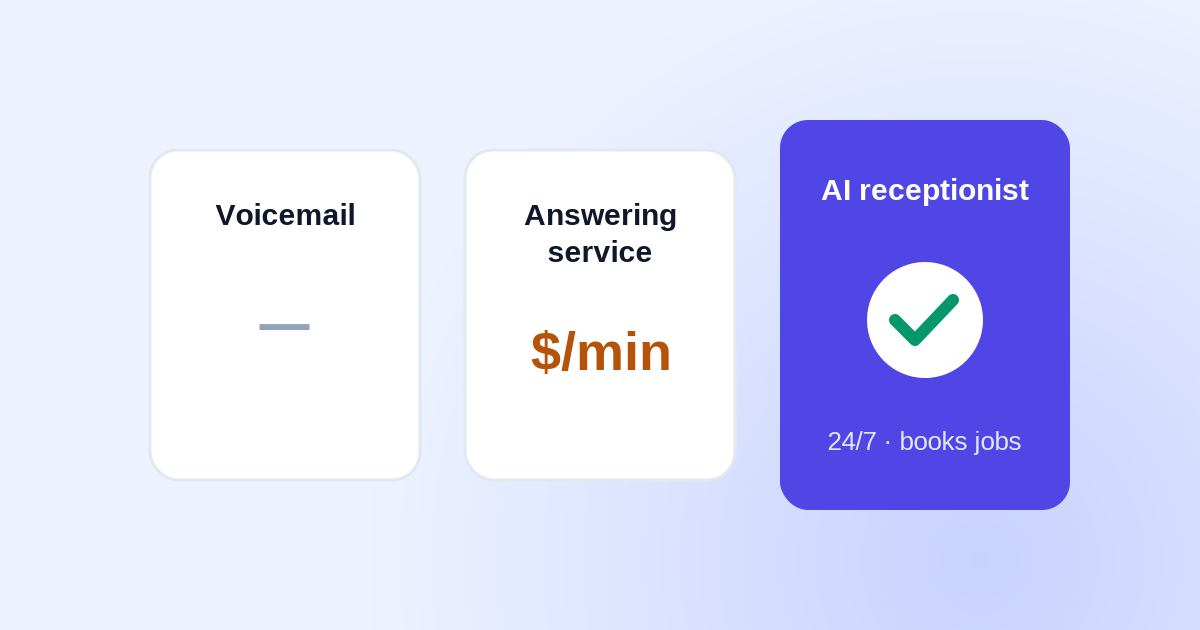
There are three common fixes — voicemail, a human answering service, or an AI receptionist. Each has a place. Here's how they compare, so you can pick the one that fits your business.
The quick comparison
| Voicemail | Human answering service | AI receptionist | |
|---|---|---|---|
| Answers live | No | Yes, during covered hours | Yes, 24/7 |
| Books appointments | No | Often, at extra cost | Yes, into your calendar |
| Knows your business | No | Script-based | Trained on your hours, services and FAQs |
| Handles call spikes | Yes (fills up) | Depends on staffing | Yes, several calls at once |
| Typical pricing | Free | Per minute or per call | Flat monthly plan |
| Best for | Very low call volume | Complex or sensitive calls | Most small businesses |
Voicemail: free, but costly
Voicemail costs nothing up front, which is why most businesses start there. The hidden cost is the callers who never leave a message. Many people, especially new customers, hang up and call a competitor rather than wait for a call back.
Voicemail still makes sense if you get very few calls, your customers are mostly repeat clients who know you'll call back, or calls are rarely time-sensitive.
Human answering services: personal, but pricey
A live answering service puts a trained person on the line. That's valuable for calls that need judgment, empathy or a complex conversation.
The trade-offs are cost and consistency. Answering services usually bill per minute or per call, so busy months mean bigger bills. At well-known providers, published plans in late 2026 started around $160–$250 per month for about 50 minutes of live answering. Agents also juggle many businesses at once, so they follow a script rather than knowing your business in depth.
A human service is worth considering if your calls are long, emotionally sensitive or legally complex, or if you need someone to handle unusual requests every time.
AI receptionists: always on, predictable cost
An AI receptionist answers every call immediately, day or night. A good one sounds natural, knows your services, hours and prices, books appointments into your real calendar and hands off to a person when needed.
What to look for:
- Booking, not just messages. The value is in turning calls into appointments.
- Easy handoff to a human. Urgent calls and hot leads should reach you fast.
- Honest disclosure. The AI should introduce itself as a virtual assistant.
- Predictable pricing. Watch for per-minute overage charges and whether spam calls count against you.
- A way to test before going live. You should be able to talk to it yourself first.
How to decide
Ask yourself three questions:
- How many calls do you miss each week? Even a handful of missed calls a week can add up to thousands in lost revenue if your average job is worth a few hundred dollars. Try our missed-call ROI calculator with your own numbers.
- What do callers usually want? If most calls are bookings, quotes, hours and directions, an AI receptionist handles them well. If most are complex consultations, a human may still be best for those.
- What can you afford every month, including busy months? Flat plans keep costs predictable. Per-minute billing can surprise you during your busiest season.
Bottom line
For most small businesses, an AI receptionist offers the best balance of coverage, caller experience and cost. Voicemail is a fallback, not a strategy. Human answering services make sense for specialized, high-touch calls.
The easiest way to know is to try it. Talk to Ava on our home page, then run a free trial on your own calls.
Will customers be annoyed talking to an AI?
Most callers just want a quick answer or an appointment. A natural-sounding AI that books them right away is a better experience than voicemail or a long hold. Being upfront that it's a virtual assistant builds trust.
Can an AI receptionist transfer calls to me?
Yes. Good AI receptionists let you set rules, such as transferring emergencies or hot leads to your phone, and take a detailed message if you don't pick up.
Is an AI receptionist cheaper than an answering service?
Usually, yes. AI receptionists typically charge a flat monthly fee for a set number of minutes, while live services bill per minute or per call. Compare the total for your real call volume.
Product & customer success
We build AI Receptionist Plus, the AI receptionist for small businesses, and spend our days helping plumbers, salons, law firms and shops answer every call. These guides come from that work.